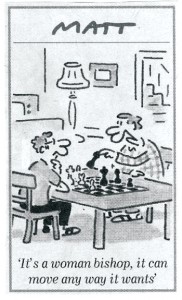
This is the Telegraph’s Matt on women bishops.  Chess pedants may suspect from the alignment of the board that Matt is not a player.  While we are on the subject, it may be worth a look at the strongest churchmen and women of all time according to The Complete Chess Addict (Fox and James 1987):
cartoon1. Fr Ruy Lopez – yes, that Ruy Lopez

2. Fr William Lombardy – GM, twice U.S. Champion, Fischer’s second in 1972

3. Rev G.A.McDonnell – perhaps the strongest of all churchmen, third in London 1872

4. Rev J.Owen – competed with Morphy and Zukertort, beat Anderssen in London 1862

5. Pope Leo XIII – brilliant as Cardinal Pecci before being elected Pope in 1878

6. Pope Innocent III – according to the authors, he stated that ‘killing after a game of chess is not a crime’

7. St Teresa of Avila – the patron saint of chess players, apparently

8. Thomas Becket – played chess with Henry II who turned out to be a bad loser

Among a powerhouse of reserves are included two more popes, Billy Graham, Cardinal Richelieu, Thomas More and Thomas Cranmer. A match between the latter two would be an interesting clash of styles.


White: Bob Page (141)                            Black: Alan Atkinson(182)

(Millar Cup: Broadstairs v Bridge B)  

Bob Page writes:  

Purists will find plenty of errors from both players in this game but it’s not every day you beat someone with a grade 41 points above your own. Some members have asked to see it so here it is. Comments – good or bad! – are welcome.

Broadstairs 1½    Bridge B 5½

1 David Faldon (170) 0-1           Richard Eales (201)
2 Bob Page (141) 1-0           Alan Atkinson (182)
3 Paul Carfrae (132) 0-1           Mark Mortimer (159)
4 John Couzens (131) 0-1           Shany Rezvany (157)
5 Andy Flood (e114) 0-1           James Essinger (155)
6 David Wheatley (106) 0-1           Patrick Burns (e137)
7 Reg Pidduck (104) ½-½           Shahid Sahi (107)

David Faldon writes:

Let’s look on the bright side. We improved on our first meeting with Bridge (1-6) and Bob won a splendid game on Board 2 against a very strong opponent. Bob (white) played the King’s Gambit and soon achieved a promising position, winning a pawn. His opponent did get a passed pawn in compensation, but Bob managed to block it. At some point it looked like a draw might result, but black tried a bit too hard to remove the blockade and Bob spotted a chance to get both of his rooks onto the seventh rank with a crushing attack. The other half point came on Board 7 when Reg also won a pawn but at the cost of a totally sterile position. Reg had eight pawns and a bishop all on white squares while his opponent had seven pawns and a bishop all on dark squares. At the end Reg (or his opponent) could have played 20 moves in a row and still not been able to make progress. Of the other games, we had some winning chances on Boards 1 and 6 but in both cases the Bridge players came up with clever defensive ideas to spoil the fun, while on Board 4 John got in his characteristic sacrifice on f7 but this time it didn’t do him any good. All in all a bit of a disappointing final score that didn’t reflect all the effort we put in against a side that outgraded us by 30 points on average. None of the games was completely one-sided and everyone can take heart that we still have two more chances to beat Bridge this season!

White: John Couzens (131)                            Black: Colin Gregory (117)

(Millar Cup: Broadstairs v Margate)  

John Couzens writes:

Have a look at this game. It is not for the faint-hearted and the old saying ‘fortune favours the brave’ fits the mad move 9. Nxf7! It could have gone either way and I now realise I should have taken the bishop on move 10 instead of Kf1. I think it would have won me a piece in the centre.  Colin texted me today to say he’d missed 12….Qh4+ wins the bishop and probably the game. Put your seat belt on and hold on tight!

Broadstairs 6 Margate 1


1 David Faldon (170) 1-0           Peter McGill (152)
2 Bob Page (141) 0-1           Harry Sharples (151)
3 Paul Carfrae (132) 1-0           Clive Le Baigue (118)
4 John Couzens (131) 1-0           Colin Gregory (117)
5 Andy Flood (e114) 1-0           Leon Garfield (101)
6 Reg Pidduck (104) 1-0           John Clarke (86)
7 Bob Cronin (101) 1-0           James Maskell (80)

David Faldon writes:

Our fifth match, our fifth … no … no … rewrite coming up … we actually won this one. Mind you, an hour into the match you’d have got a good price against that happening. We were a queen for bishop and knight down on board 4, a rook for knight down on board 7 and a whole rook down on board 2. True, we were a nice pawn up on board 3 but that hardly seemed sufficient compensation. The carnage started on board 4. John (white) sacrificed a knight on f7 with his ninth move, attacking queen and rook, but instead of taking the knight, Colin counter-sacrificed a bishop on f2 with check. John could have captured this bishop with his king with a roughly equal game but instead he tried Kf1, dropping his queen to a knight fork on e3. Oops. Amazingly, that wasn’t the end of the game. John regrouped and, after a few mistakes from Colin, he was back with a few threats of his own. Meanwhile on board 2, and also on move nine, Bob P (white) was faced with a knight sacrifice on his f2 square, forking rook and queen. Bob could have captured this pesky knight with his king, emerging just a pawn down, but instead he moved his queen, bravely sacrificing a whole rook …Three spectacular sacrifices on f2/f7 in two games, and a few moves later there came a fourth when Margate’s board 1 (white) couldn’t resist throwing in a Nxf7 sacrifice, attacking black’s queen and rook. This time the capture king takes knight wouldn’t have been good, nor would moving the queen, nor would moving the rook, nor would counter-sacrificing against white’s king, but instead David found a fifth way, a queen sacrifice. Amidst all the mayhem some calm chess was going on. Paul on board 3 was a safe pawn up, Andy on board 5 had a big passed pawn and Reg on board 6 had cleverly swapped both of his bishops for his opponent’s knights. In the blocked-up position that resulted Reg’s knights could hop this way and that while his opponent’s bishops just got in the way of his rook. Three much-needed wins for Broadstairs on the way? In fact two wins for Broadstairs did turn up pretty soon. The first came from an unexpected source, board 7. Bob C’s (unintentional) rook for knight speculation paid a big dividend when his knight popped out of the way of a discovered check to win his opponent’s queen. The second win came on board 1 when a long swap-off sequence left David a clear bishop up. 2-0 soon became 2-1 when Bob P’s swindling chances evaporated but Paul and Reg and John all cashed through for wins. 5-1. In the last game to finish Andy found a nice rook for knight sacrifice to defuse his opponent’s last flicker of hope. 6-1. In the end a comfortable win, but the lopsided 6-1 result was, in truth, a bit flattering. Still, we’ve played well and lost matches in the past, so we should celebrate this win while we can. I’m sure that the return match at Margate in January will be interesting.