Congratulations to Michael Doyle on another excellent win, this time against Richard Clement in Round 1 of the Summer  Swiss. This is a competition that takes place towards the end of the season when many clubs go into hibernation (or estivation to be more accurate). It gives those players who have completed their club championship games something else to play for and this year we have attracted a good turnout of fourteen players. The prize goes to the player with the best grading performance over the five rounds  – so Michael is already in a strong position – and the competition ends in August.  Michael’s victory is another notable scalp as Richard has been in excellent form this year. Already his grade has risen from 129 to 145 and as there has been no let up since January, it may well improve again when the next list comes out. With 15½/17 in the club championship, Richard may not quite be the leader in the clubhouse yet with two games to play but he is probably approaching the 17th green. However, he has two strong opponents in Arnaud Wisman and David Faldon still to play and both like Richard are hitherto unbeaten. As for Michael, he is clearly playing above his grade and he will be hoping to finish the league season on a high note with a win in our final match of the season on Monday against Sheldwich. Victory would secure second place in the Walker Shield.

White:  Michael Doyle (86)        Black:  Richard Clement (145)

2019 Summer Swiss  

It is no secret that chess is played by considerably more men than women. The reasons for this are many but the question is how can women be encouraged to play (or return to) chess and is the situation the same worldwide? Hammersmith Chess Club is doing its bit by holding a chess month during May in which there will be various events to promote the game with women in mind.  These include a series of lectures by Women’s FIDE Master Maria Manelidou, a women’s rapidplay tournament with £250 in prize money and special offers on membership for women players who wish to join the club during May. The initiative is supported by the ECF (see here) and Chris Fegan, ECF Director of Women’s Chess wrote: “It is (at least to my knowledge) the first ever such month-long series of activities specifically designed for women that an English chess club has ever put on.” Full details can be found on the Hammersmith Chess Club website.

As regards female participation in chess worldwide, there was a very interesting blog posted recently that is recommended reading for anyone interested in the topic. The article is entitled ‘The Best (and Worst) Countries to be a Female Chess Player” and is prefaced by this summary: ‘Female participation rates are higher in countries that are traditionally patriarchal. Various theories are discussed. Federations seeking to boost female participation should concentrate on teaching chess to girls in or before primary school, as well as encouraging young adult women to stay in the chess world.’

The article is too detailed to comment on further here but you might be surprised by the research and conclusions that the author, David Smerdon, provides. As a taster, try this question for starters: guess which of these countries have the highest percentage of female chess players: Brazil, China, Denmark, France, Germany, India, Indonesia, Iran, Kenya, Mexico, Netherlands, South Africa, Sweden, United Kingdom, USA, Vietnam.

Intrigued? Then read the article here.


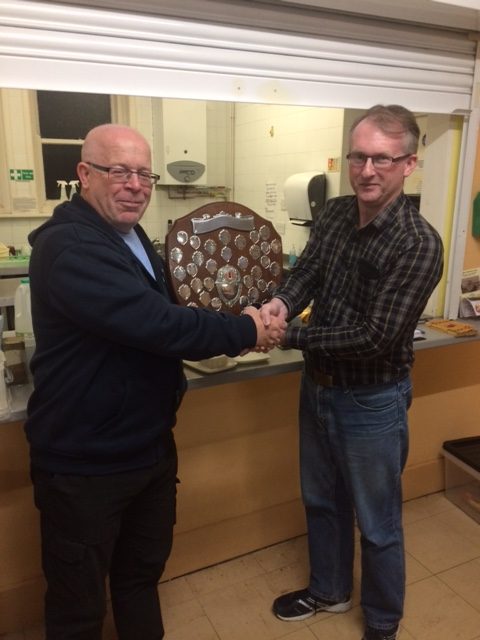
Trefor receives the Micklethwaite Shield

Congratulations to the Broadstairs A team who won the Team Buzzer tournament for the third year in a row. Sadly, as has become routine in recent league events, only three teams competed and two of those were from Broadstairs so we should be grateful to Margate for at least making it a competition.  Had they been at full strength it would have been closer than it was but the absence of one or two of their stronger players together with (or perhaps because of) the fact that buzzer events – you have to move every ten seconds on the buzzer – are not everyone’s cup of tea meant that the real competition was for second place.  Here Paul Johnson justified his selection on Board 1 for the B team by drawing with Trefor Owens – the only individual game that the A team did not win – and twice beating Peter McGill, the Margate number one.

It is to Broadstairs’ great credit that not only could the club count on eight players to take part but that two others offered to stand by if needed as reserves. Indeed one of those, Paul Carfrae, stepped in at the last minute. This is the club’s fourth trophy this season after the Team Quickplay, the Mick Croft Cup and the Hargreaves Shield. With second place in the Millar Cup and the possibility of second in the Walker Shield which concludes on Monday, it has been an excellent season. Many thanks to all those who took part and to Margate for their hospitality.

A team: Trefor Owens, Shany Rezvany, David Faldon, Ian Hames

B team: Paul Johnson, Bob Page, Paul Carfrae, Michael Doyle

Team Played Won Drawn Lost Game Pts Match Pts
Broadstairs A 4 4 0 0 15½ 8
Broadstairs B 4 2 0 2 6½ 4
Margate 4 0 0 4 2 0

Full details of individual results can be found on the ECF LMS site.

Here at Game of the Week HQ we are naturally partial to games where the underdog puts one over on a more exalted opponent. While this game may not quite qualify as a David v Goliath encounter, beating an opponent 26 points stronger is nonetheless a commendable achievement.  There is a theory – almost a truism – that chess players often do better against stronger opponents, whether the result of unintentional complacency, concentration (or lack of) and Michael seems to have become a convert: this fine performance was sandwiched between two games in the Walker Shield where he was less  successful against lower rated players.

White:   John Couzens (117)     Black:  Michael Doyle (91)

Goodall Cup  

Photo courtesy of Brendan O’Gorman

And so to St Albans which has been something of a pilgrimage for this writer over the years. A combination of spring sunshine and lakeside walks in a city of historical significance forms an attractive background to a chess congress. ‘Pilgrimage’ is an appropriate word to use as part of the city’s importance is its religious history. St Alban was the first British martyr, executed in the 3rd or 4th century for sheltering a Christian priest from the Romans, and St Albans Cathedral now stands near the believed site of his execution.  The Romans had named the settlement Verulamium and its significance continued through Anglo-Saxon and medieval times. The Wars of the Roses began with the Battle of St Albans in 1455 and a second battle was fought there six years later.

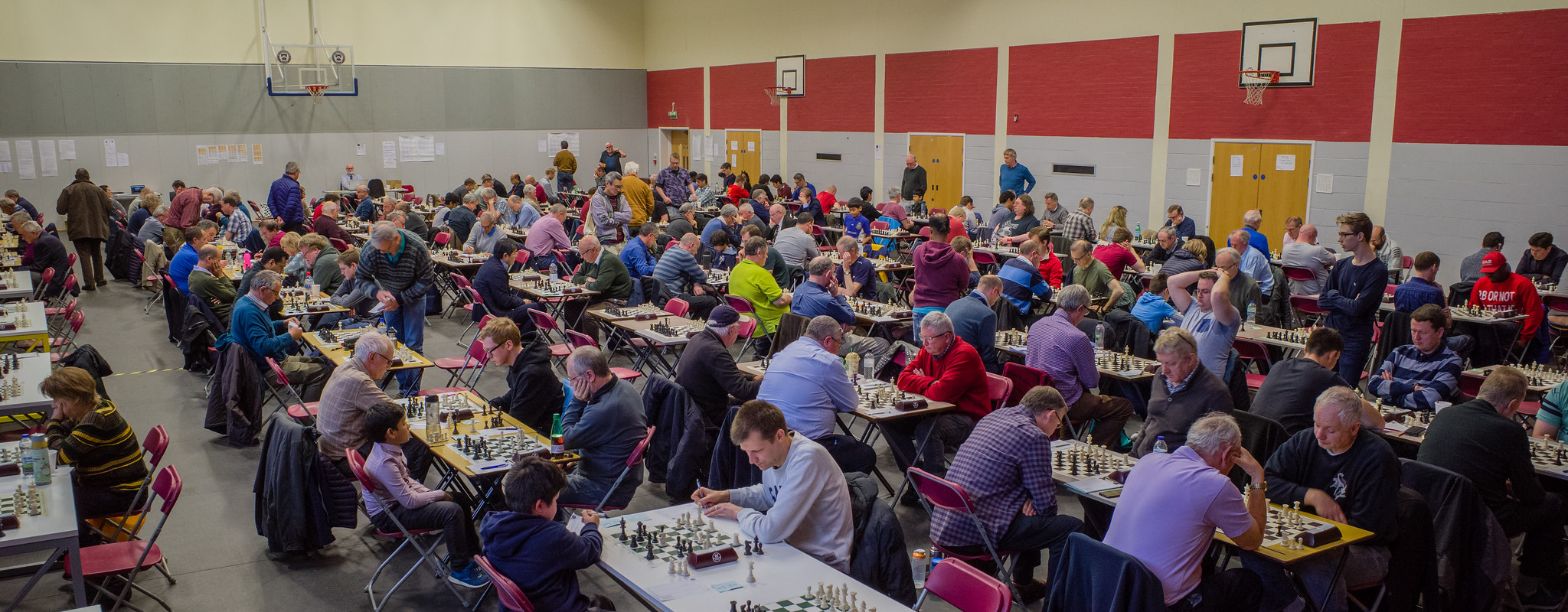
The chess congress is in its 37th year. Its former home was St Albans School situated in the town centre – St Albans feels too small to be called a city – which was ideal for the shops, pubs and bookies (the congress invariably seems to coincide with the Grand National) but less convenient for car parking.  The current venue, St Columba’s College, is a longer walk from the centre but car parking is not a problem. The walk around the lake in Verulamium Park is a pleasant one where herons can be found nesting at this time of year and RSPB volunteers offer their ‘scopes’ for viewing.  The congress is always popular. Easy access from London and the timing of the congress during the Easter school holidays traditionally guarantees around 200 players of all ages. This year saw a record turnout of 250 and the online entry was closed a few days early. One of the unlucky ones who ‘missed the cut’ was Toby Stock, formally of this parish, who turned up nevertheless hoping in vain for a late withdrawal. Another former Broadstairs member, Oliver Finnegan, who did make the list probably wished he hadn’t bothered as despite being graded near the top of the Major, he lost two of his first three games and promptly withdrew.

The congress is run by St Albans Chess Club and it’s not clear who is in charge as there always seems to be an army of volunteers. Ray Claret and Terry Douse are two and Michael Flatt and Tony Corfe were the arbiters. Two is probably the minimum required in a hall with 250 players (see the above photo).  Fortunately for them, everything seemed to run smoothly this year with a couple of clock problems and a minor injury appearing to be the only hiccups. Prize money totalled £3,400 and this was increased on the day to take into account the strong turnout. Consequently, five extra prizes were awarded to the ‘lucky losers’ – those who just missed out on a prize in each of the five sections.

The Open had an impressive lineup, headed by GM Chris Ward and IMs Richard Pert, Richard Bates (last year’s winner), and the latest chess wunderkind, ten year old Shreyas Royal, who already has an ECF grade of 186. All were muscled out of the way by the eventual winner, John Merriman, of the Drunken Knights, who may not be quite so drunk in the immediate future as they have just been turfed out of the pub that has been their home for 29 years. Merriman defeated Bates in the last round to finish on 4½/5 while Ward and Pert drew. Full results can be found here and click here for more of Brendan O’Gorman’s photographs of the congress.