Broadstairs  1½         Bridge   2½                                        

1 Andy Flood (110) ½-½ William Peak (104)
2 Reg Pidduck (101) ½-½ James Smith (94)
3 Bob Cronin (101) ½-½ Graeme Boxall (93)
4 Michael Doyle (90) 0-1 Ian Redmond (80)

Reg Pidduck writes:

BOARD 2. DRAW NO 1.  James played an English which threw me from the start (I must gen up on it). We got through to a king and pawns endgame. James’s pawns were more advanced and my queenside pawns were a shambles so prudently I took the draw James offered.  Good play, James. I hope we play again. ½-½

BOARD 3.  DRAW NO 2. Bob played his Fried Liver and was in control for a while . Not sure what happened next but Graeme’s position was soon equal and although Bob was down to the sixth rank he could not break through and after many king moves each, neither could afford to back off. So a draw was agreed.  Score now 1-1

BOARD 1.  DRAW NO 3. Young William Peak looks a fine prospect as not many players in the Walker Shield can gain such an advantage over our board 1. Andy was on the ropes with only a rook against knight and bishop until he gained an advanced pawn and a draw was agreed with neither in an position to withdraw. 1½-1½

BOARD 4. NO DRAW IN THE LAST. Captain Michael could have had another draw.  He told me that had he taken a knight with a rook instead of with his king it would have been a different game. But in Michael’s words “Woe is the crestfallen as it was not to be”. So well done, Ian Redmond, and all the Bridge team for a 2½-1½ victory.


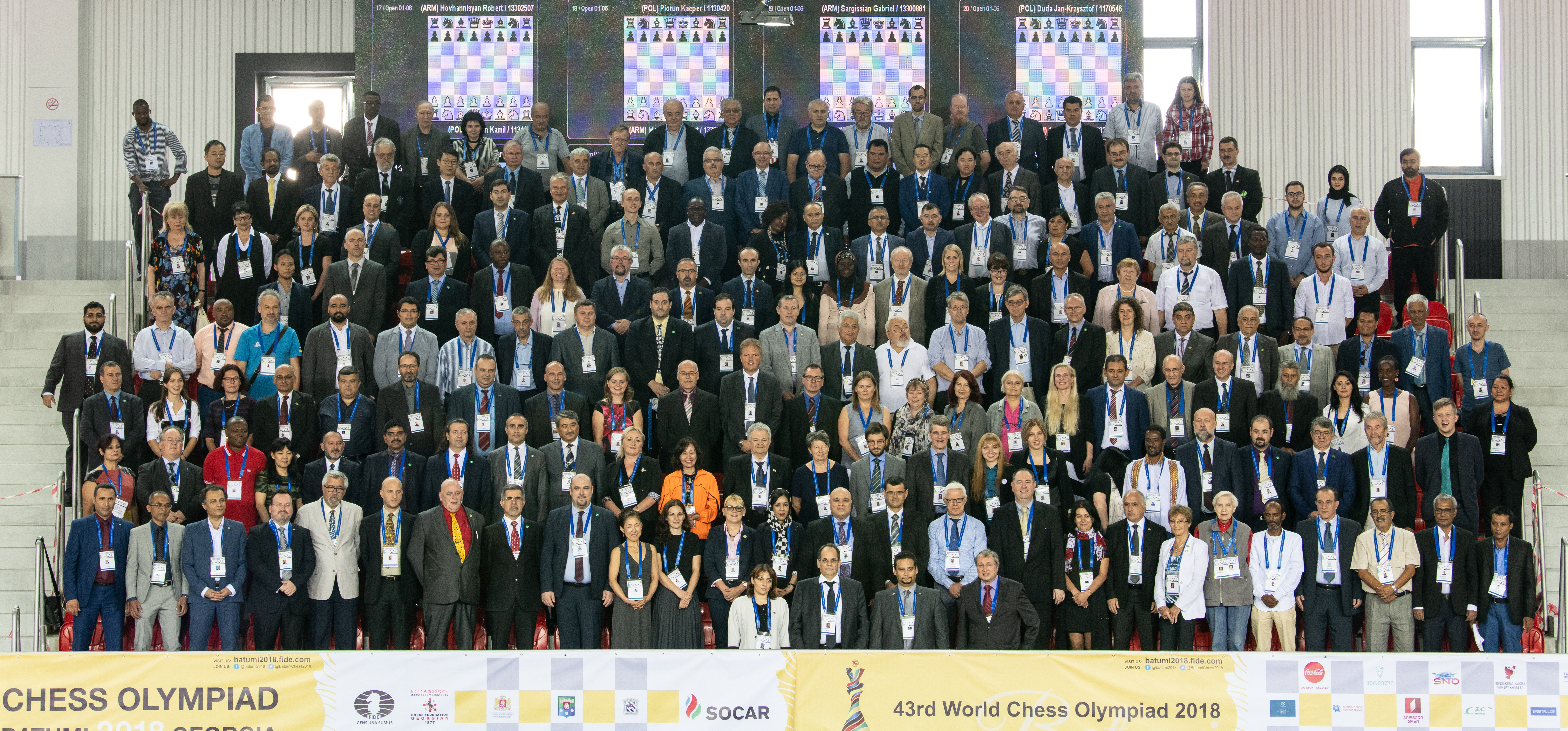
This photograph was taken during or possibly after the Chess Olympiad and it shows all the tournament’s arbiters, the sheer number of which gives you an idea of what a vast event it must have been. Of particular interest to local readers is the presence of the former league chairman and Bridge Chess Club stalwart, Alan Atkinson, who was attending the Olympiad in an official capacity. But can you spot him? If you want a clearer picture before trying to work it out click here to download a higher resolution photo.   I’ll give you the answer under the photo. There was an interesting debate on the English Chess Forum as to the collective name for a group of arbiters and someone – to be fair, this was following some criticism of one or two – suggested the term ‘incompetence’! This brought about a reply from the former chairman himself who rightly described it as ‘harsh’ although he added that ‘there were the usual tales of some arbiters being useless/asleep/absent/etc’. 

Alan Atkinson is second from the left in the second main row from the bottom.

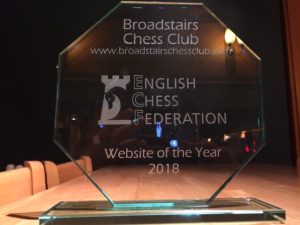
In the summer we received the glad tidings that this site had been named Website of the Year by the ECF and in our naivete we assumed that that was that and with that we were satisfied: the kudos of winning was enough. Now imagine our surprise then when a further email was received last week asking to whom the award should be sent! And here it is….as Reg said, it is really, really nice: modern, stylish, distinctive and…er…slightly wrong.

The bad news is there is a minor error. The good news is it is not easy to spot. In fact, if I thought I’d get any takers, I might offer a year’s free membership of Broadstairs Chess Club to the first person to find it. It’s made even more difficult to see in this photo by the unintentionally cunning position of the award in relation to the lighting. Yes, if you look very closely, you will notice that the website address on the award is listed as www.broadstairschessclub.com and as all our regular visitors know, we are www.broadstairschessclub.co.uk.

A minor error like this might in some circumstances be overlooked. However, when the award is for Website of the Year and the website address listed is incorrect, it manages to be both amusing and embarrassing at the same time. Fortunately, the ECF saw the funny side, too. A replacement has been ordered and the offer to return the original was declined ‘in case you create a second, international site’. So we await the second coming and another presentation at the club. Like all awards ceremonies, this one promises to run and run.

                                            Broadstairs  5½         Margate 1½ 

1 David Faldon (175) 1-0    Peter McGill (149)
2 Trefor Owens (167) 1-0    John Thorley (140)
3 Shany Rezvany (163) 1-0    Colin Gregory (119)
4 Bob Page (144) ½-½    Clive Le Baigue (111)
5 Paul Carfrae (141) 1-0    Leon Garfield (101)
6 Richard Clement (128) 1-0    John Clarke (98)
7 Michael Doyle (90) 0-1    Roy McAloney (86)

David Faldon writes:

What seems a comfortable win actually wasn’t. We were 1-0 down for a long time, with several of the other games looking either dodgy or drawish. It was a relief when Shany converted his extra exchange into a win on board 3 and Bob secured a draw on board 4. All four of the remaining games went into the last half-hour when the time left on a player’s clock starts to be important. Richard was a couple of pawns up for not much compensation on board 6 and in the other three games the Margate players had much less time, so at last the situation began to look favourable. In the end we won all four games. Trefor’s game on board 2 looked the most interesting, a delicate knight versus bishop ending that is possibly a bit too long for a game of the week, with Shany’s tactical mess a close second. We’ll have to see what the webmaster decides. Well done to the team on our first Millar Cup win of the season, and congratulations to Margate on putting up such a tough fight despite the wide gap in ratings on most of the boards.

The 43rd Chess Olympiad is over and we can now (almost) confidently announce the winners. Chess 24 has all the results and if you click on ‘standings’, it has the following: 1. USA 2. Russia 3. China. All three are level on 18 MP (match points?) but the USA and Russia have 29 BP (board points?) to China’s 28½ so that seems to suggest a tie break between the USA and Russia which could be fun. However, a check on chessresults.com shows four separate tie breaks with TB4 appearing to carry most weight although it’s not clear what it stands for. Crucially, though, it has China first with 149, the USA second with 147 and Russia third with 144. All three teams won 8, drew 2 and lost 1. (Incidentally, congratulations to the England team who won 8 drew 1 and lost 2 to finish in an excellent fifth place – their best finish for 22 years.)

There was still confusion amongst contributors to the official website’s message board even while the closing ceremony was taking place. This was an event in itself with medals handed out like confetti in a programme interspersed with an unusual choice of songs from local singers (‘Chain Reaction’, ‘Cabaret’) adding to the consternation of chess fans messaging (“Who is this woman?” “No, not another song! Where’s my gun? I can’t stand any more!”), alongside some more unrepeatable remarks, the most charitable of which questioned her ELO rating. Medals were handed out for first, second and third individuals in five categories: reserve then boards 4, 3, 2 and finally 1.  With some confidence I can announce that Ju Wenjun of China won the prize for best women’s performance on board 1 with 7/9 and Ding Liren for best male on board 1 with 5½/8. However, a further ‘gold medal’ was then awarded to Ju Wenjun – ok, this seems to confirm her place as overall female individual winner – and Jorge Cori from Peru, who scored 7½/8 including seven games as White! He was rested for the last round, perhaps to protect his score.   One can only assume that there must be some seeding of opponents faced when judging the individual winners because England’s board 1, Jovanka Houska, had a terrific tournament, losing only one game and finishing with 7½/9. However, two of her opponents were under 1800 whereas Ju Wenjun did not face anyone below 2300.

                           Ding Liren

After yet more music the final medals for the top three teams were awarded. (There had earlier been medals for the top three teams in about four other categories but remember – there were almost 200 teams taking part.) Eventually, China was confirmed as winner of both the men’s and women’s competitions although, interestingly, the tournaments were named ‘Women’ and ‘Open’.  After each of the team winners was announced, an anthem was played and everyone stood up but whether this was the Chinese national anthem or a FIDE anthem – one wag suggested ‘Georgia on my mind’ would be more appropriate – was not clear and the Chinese players certainly did not seem to accord it much reverence.  As for Wei Yi, he had a rather modest tournament. After winning his first two games, he did not win another, was not selected for the last two matches and finished on 3½/7. Congratultions to Ding Liren, however, who was unbeaten in the competition, played for the winning team, took the medal for the best performance on board 1 and played one of the best games in the tournament in the crucial defeat of Poland in the penultimate round.


White:  Ding Liren (2804)      Black:  Jan-Krzysztof Duda (2739)

 43rd Chess Olympiad (Batumi) Round 10